
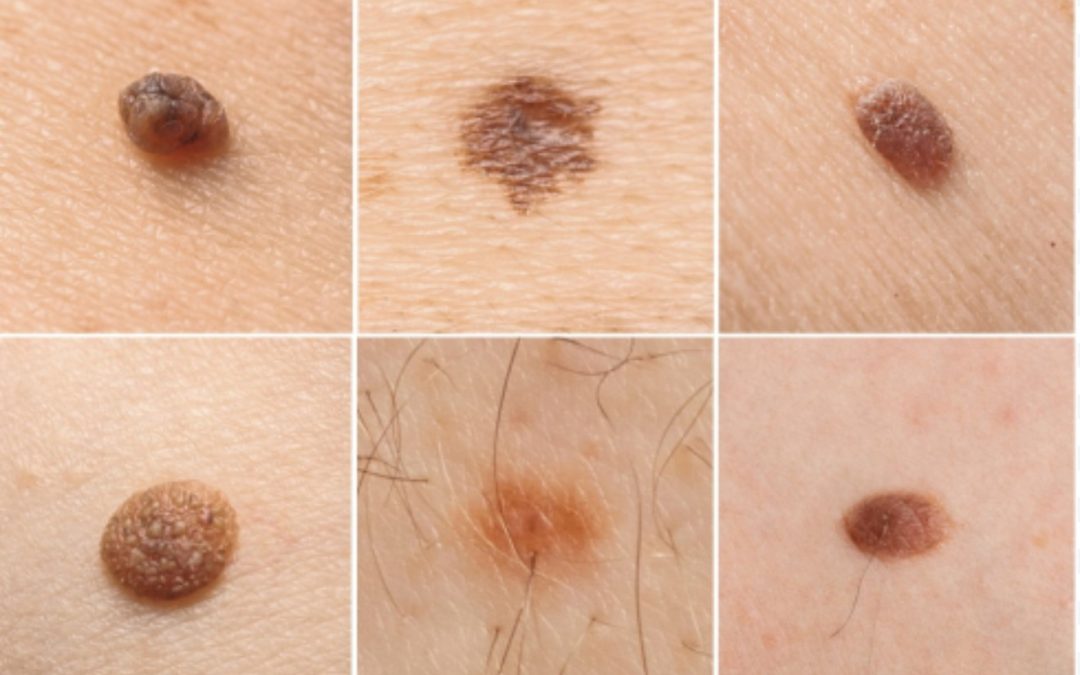
How to Spot Unusual Moles?
At first glance, it can be tricky to see how an atypical or unusual mole differs from a normal mole. Below are some warning signs to watch for.
We often use the ABCDE rule to identify features that may suggest a mole needs medical attention.
A – Asymmetry
Most melanomas are asymmetrical. If you draw a line through the middle of the lesion, the two halves don’t match, so it looks different from a round to oval and symmetrical common mole. Normal moles are usually symmetrical.
B – Border
Look for irregular, scalloped, notched, or blurred edges. Common moles tend to have more smoother, more even borders.
C – Colour
Multiple colours are a warning sign. While benign moles are usually a single shade of brown, a melanoma may have different shades of brown, tan or black. As it grows, the colours red, white or blue may also appear.
D – Diameter and Dark
Some experts say it is also important to look for any lesion, no matter what size, that is darker than others. Rare, amelanocytic melanomas are colourless. Moles larger than 6 mm (about the size of a pencil eraser) should be checked. However, size alone doesn’t mean danger, but large changing moles should be checked.
E – Evolving
Any change in size, shape, color, or elevation as well as new symptoms such as itching, bleeding, crusting, or becoming tender must be checked by the doctor.
Additional warning signs
These aren’t part of ABCDE but are also important:
1. The “Ugly Duckling” sign
• A mole that looks noticeably different from your other moles.
2. Rapid growth
• A mole that changes quickly over weeks or months.
3. New moles after age 30
• Not always dangerous, but new moles in adulthood should be monitored.
4. Persistent itching or pain
• This could be a sign of irritation or something more serious.
5. Sores that don’t heal
• A mole that becomes an open sore or repeatedly bleeds.
When to see a Plastic Surgeon?
You should get a mole evaluated if:
- It shows any ABCDE features
- It starts itching, bleeding, or scabbing
- It is new and changing
- You have a family history of melanoma
- You have many moles or freckles and want routine exams
Regular skin checks at home and yearly professional skin exams can make a big difference.
When to book a spot check?
If you notice anything unusual or changing mole promptly consult a healthcare professional. It is recommended you check your skin thoroughly once a month, although if you have previously suffered with skin cancer you may well be required to check more frequently.
How to perform a skin self-examination?
- Examine your entire body in a well-lit room, using a full-length mirror and a hand mirror for hard-to-see areas
- Check your scalp, the soles of your feet, between your toes, and under your nails
- Look for new moles, changes in existing moles, or any spots that itch, bleed, or don’t heal
- Use the ABCDE rule to evaluate moles: Asymmetry, Border irregularity, Colour variation, Diameter larger than 6mm, and Evolving shape or size.
Recent Comments